
The rise of AI in pharmacy-based skin health
You might have experienced a strange rash or spots on your skin, and wondered if it needs something more than home based care, something a pharmacist can handle or if you need to see a specialist? You are not alone. In fact, skin concerns are among the most common reasons people seek advice from their local pharmacy. Think of the new parent worrying about their baby’s sudden rash, or an elderly person trying to get a clear look at a changing mole on their back. For most of us, the first instinct is to seek fast, accessible guidance close to home.
Accessing a dermatology specialist is a significant challenge across Europe. Patients often face long waiting times. This creates uncertainty and puts additional pressure on primary care services.
The scarcity of specialists is clear. The UK has only about 750 dermatologists, while Ireland has just 50 and Sweden around 650. Even Germany, with approximately 6,000 specialists, struggles to meet patient demand.
In response, community pharmacies are becoming a vital first point of contact. They offer trusted advice both in-store and online to help people understand their next steps. This crucial role allows pharmacies to manage common health concerns, off-loading a huge burden from family doctors and specialist systems.
In an era where newer technologies are being incorporated more into primary health care, to keep up with this demand safely, pharmacy chains are now adopting digital tools that can help more people without increasing clinical risks. Basically, AI supported skin screening tools being utilized by pharmacies has been a smarter solution. This tool helps to resolve minor problems quickly, help people to visit dermatologists for urgent conditions, which in turn helps reduce long waiting lists for specialists.
The pharmacy challenge: high demand, limited specialist access
| The Old Way | The New Way with an AI Skin Scanner |
| Long waits for specialists | Instant informational guidance |
| Patient uncertainty & anxiety | Empowered, informed customers |
| Overburdened pharmacy staff | Focused, efficient consultations |
| Generic advice | Data-driven, personalized pathways |
Pharmacists deal with skin-related questions every single day. Customers often describe their symptoms out loud or show photos on their phones, looking for reassurance or direction.
However, this creates a few big challenges like,
- Time and Expertise: Listening to every detail and studying photos takes a lot of time
- Legal Boundaries: Even though pharmacists are highly trained, they are not allowed to officially diagnose skin conditions
- System Backlogs: Across Europe, it is becoming harder to see a specialist due to long waiting lists and limited space
Because of these boundaries, pharmacy groups are looking for digital solutions to help people get earlier awareness and better guidance. These tools must be safe, private, and follow strict medical rules.
On the other hand, the users expect these tools to be mobile friendly, allowing self service and fast enough to provide immediate feedback. So collectively the aim is to pr
Meet the AI skin scanner
To address these challenges, a leading European pharmacy chain introduced a AI Skin Scanner. This digital tool is in order to provide health services easily.
Here is why it’s so simple to use
- Easy and Private: You just upload a photo of your skin concern through an anonymous website or app
- High-Tech Analysis: The image is checked by Autoderm’s medical-grade AI. This AI is officially registered and meets high safety standards (CE-marked and MHRA-registered)
- Instant Guidance: After the system go through a library of similar skin images,you get a list of possible skin conditions and advice on what to do next. This information is for your awareness and helps you plan your next steps
- Built for Your Phone: The tool is fast, keeps your data private, and works perfectly on mobile devices
The pharmacy stays in total control of the experience and branding. While you see the pharmacy’s familiar face, Autoderm’s AI works quietly in the background to analyze the images.
How the Autoderm-powered AI skin scanner operates
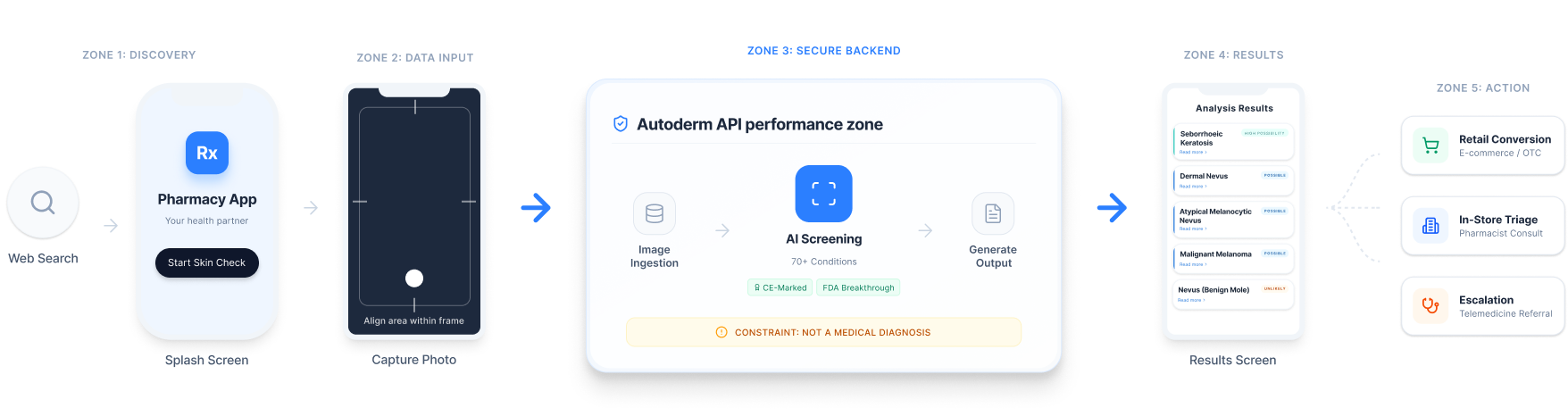 Autoderm API user journey and system integration within a pharmacy app
Skin analysis tool designers have made sure it being as simple as taking a photo. Here are the simple steps of using the app.
Step 1: Image Upload Within the App
You can find the skin scanner directly inside your app. You don’t need any special equipment or extra gadgets your standard smartphone camera is all you need. To help the AI work its best, the app provides clear tips on how to use good lighting and how to frame the area of concern.
Step 2: AI Image Analysis (Autoderm API)
Once you upload the photo, the Autoderm system gets to work. It compares your image against a massive, constantly updated library of professional skin images. The process is quick and only requires a single photo to identify a wide range of common skin conditions.
Autoderm is bound to ensure the safety and quality of the results you receive.
Step 3: Results Presented to the User
The results are shared with you in plain, non technical language. You will see a list of the most likely possibilities to help you understand what might be going on.
It is important to understand that these results are for your information only and are not a formal medical diagnosis. Since everyone’s skin is unique, you should always talk to a doctor or GP if you are worried.
Step 4: Deciding on Your Next Move
At this point, responsibility shifts entirely to the app provider. After you see the results, the app helps you decide what to do next. Autoderm provides the information, but the app itself connects you to actual care. Depending on your results, you will be asked to
- Visit a Pharmacy: Good for minor issues that can be handled with over-the-counter care.
- Book a GP Appointment: Use the app to schedule a visit with your regular doctor.
- Speak to a Specialist: Some apps offer a way to get a full review from a human dermatologist through a video call or a telemedicine service.
- Take No Action: If the results provide the reassurance you needed for a minor, self-limiting concern.
The responsibility of Autoderm in this process is only to analyze the image you’ve provided. It does not contribute to providing medical advice, writing prescriptions, or making treatment decisions. Those steps are handled separately by the app’s other clinical service providers.
These apps know that health data is sensitive, so your photos are processed and stored anonymously, meaning no personal details like your name or address are attached to them. This system is built to follow strict European data protection rules to keep your information safe.
From Patient Anxiety to Customer Loyalty
This journey from a moment of worry to a feeling of empowerment is the core of the customer experience. By providing a trusted, immediate answer, pharmacies are not just solving a health query; they are building lasting trust. A customer who feels understood and guided is far more likely to rely on the pharmacy for future health and retail needs, transforming a single digital interaction into long-term loyalty.
This journey from a moment of worry to a feeling of empowerment is the core of the customer experience. By providing a trusted, immediate answer, pharmacies are not just solving a health query; they are building lasting trust. A customer who feels understood and guided is far more likely to rely on the pharmacy for future health and retail needs, transforming a single digital interaction into long-term loyalty.
Why pharmacies use Autoderm’s AI: key benefits

- Improved Accessibility – Users gain rapid, anonymous informational screening without barriers to entry.
- Enhanced Engagement – Users proceed with clearer expectations, leading to more targeted interactions with pharmacy services.
- Support for Pharmacy Teams – Structured AI outputs provide context for conversations without replacing professional judgement.
- Scalable Deployment – Consistent performance across large store networks without extensive staff training.
- Clear Separation of Roles – AI provides information; pharmacies define retail and clinical pathways.
- Fully White-Labelled Integration – The pharmacy brand remains primary; Autoderm remains invisible to end users.
- Regulatory Alignment – Designed to meet CE, MHRA, GDPR, and privacy-by-design requirements. FDA Breakthrough Device Designation reflects innovation within an established regulatory framework.
Real-world outcomes observed
Following launch, user adoption was rapid, with strong engagement across digital channels. Internal validations and independent testing indicated reliable performance across a wide range of common skin concerns.
In anonymised evaluations and media testing, the AI Skin Scanner demonstrated the ability to surface relevant informational results across both common and less frequent conditions. Feedback highlighted usability, speed, and clarity of communication.
Pharmacy teams reported greater confidence when discussing skin concerns, while users benefited from earlier awareness and clearer guidance on when to pursue self-care or professional review. The availability of optional escalation to human review, offered by the pharmacy, further reinforced user trust.
Early indicators of strategic impact for pharmacy chains
Early indicators suggested broader strategic value for pharmacy organisations:
- Increased digital traffic and user dwell time
- Differentiation through visible health innovation
- Strong alignment with pharmacy-led education and training initiatives
- Integration into omnichannel healthcare strategies
- Improved operational efficiency through clearer triage pathways
By clearly separating AI-based information from medical care, pharmacies can expand access while maintaining trust and regulatory clarity.
Future potential: expanding AI dermatology across pharmacy ecosystems

Pharmacy chains are looking for new ways to make skin care even easier for you. Soon, you might see these tools in more places, such as:
- In-Store Kiosks: Simple touchscreens inside the pharmacy where you can quickly check a skin concern while you shop.
- Specialized Help: New guides specifically for long-term skin issues like acne or eczema.
- Better Apps: Faster and more helpful features built right into the pharmacy app on your phone.
By looking at anonymous data, pharmacies can also learn which skin problems are most common in your area. This helps them stock the right medicines and plan better health services for the whole community.
Conclusion: AI as a responsible frontline support tool in retail dermatology
In this model, pharmacies increasingly serve as the first point of contact for everyday skin concerns. By integrating Autoderm’s medical-grade AI, pharmacy chains can facilitate informational access while upholding safety and trust, retaining full control over retail and clinical pathways.
The clear separation between AI analysis and medical care supports regulatory compliance, protects users, and enables pharmacy teams to operate with confidence. As demand for dermatology services continues to grow, AI-supported tools offer a responsible way to scale access without blurring professional boundaries.
FAQ: How does AI skin analysis support pharmacy teams without creating clinical risk or regulatory liability?

Answer: AI skin analysis in pharmacy settings is designed to operate as a “digital front-door” information tool, strictly separated from diagnostic or prescribing decisions. It serves as an early engagement layer, allowing customers to check their skin concerns anonymously and receive immediate, structured guidance before they even speak to a pharmacist. This process empowers customers with better information, helping them decide whether a concern might be suitable for over-the-counter (OTC) care or requires professional escalation.
To ensure safety and minimize liability, the technology functions as a CE-marked, medical-grade API that provides informational output only. It does not make a diagnosis. Instead, it generates a ranked list of potential conditions, which helps frame the subsequent conversation with the pharmacy team. Critically, the pharmacy retains full control over the “next steps”;whether that is recommending a product from the retail shelf, inviting the customer for an in-store consultation, or signposting them to a GP.
Operationally, this reduces the burden on pharmacy staff by filtering out low-acuity queries and providing a standardized starting point for consultations. If the AI detects ambiguity or high-risk features, it automatically safeguards the user by suggesting professional review. This distinct separation of roles, AI as the information provider, the Pharmacist as the clinical decision-maker ensures the service remains compliant with pharmacy regulations while driving digital engagement and in-store footfall.
References
- Escalé-Besa A, Yélamos O, Vidal-Alaball J, et al. Exploring the potential of artificial intelligence in improving skin lesion diagnosis in primary care. Sci Rep. 2023;13:31340. Published March 15, 2023. doi:10.1038/s41598-023-31340-1
- Börve A, Molina-Martinez R. A pilot study of a medical information service using mobile phones in Sweden. J Telemed Telecare. 2009;15(8) https://doi.org/10.1258/jtt.2009.009002
- Zakaria A, Maurer T, Su G. Impact of teledermatology on the accessibility and efficiency of dermatology care in an urban safety-net hospital: a pre-post analysis. J Am Acad Dermatol. 2019;81(2)