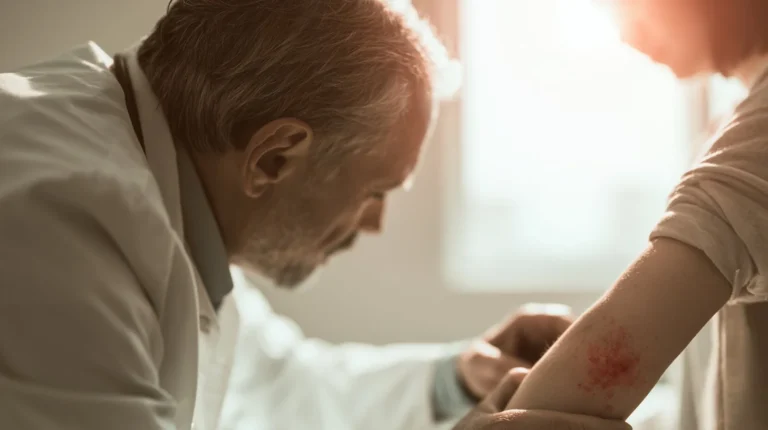
Teledermatology is not telemedicine with a skin filter applied to it. In general primary care, AI pre-triage helps a GP decide whether a skin concern warrants a referral. In teledermatology, the dermatologist is already the endpoint. The question shifts from whether to refer to how to use specialist time well once the patient arrives.
Germany makes this distinction sharp. With approximately 6,000 dermatologists serving 84 million people and referral wait times averaging 4 to 8 weeks, every specialist consultation carries weight. A teledermatology platform that uses AI to ensure cases arrive in the best possible condition is doing something more valuable than simply absorbing referral demand.
The teledermatology model and where AI fits
Store-and-forward and the case quality problem
Teledermatology operates across two models. Synchronous consultations use live video. Store-and-forward consultations work differently: the patient submits images and clinical notes asynchronously, a dermatologist reviews them independently, and a written response is returned. In the store-and-forward model, image quality and case completeness at submission directly determine what the specialist receives. A blurred photo or missing clinical detail can force a follow-up request that delays the entire case.
Autoderm’s API sits at the submission stage, processing the uploaded image before any human reviewer opens the file. It returns a ranked list of informational condition suggestions with confidence levels. This gives the user an immediate informational response while the case is in the queue, and gives the dermatologist context before the consultation begins.
What the clinical evidence shows
Real-world performance and suggestion accuracy
The clinical case for Autoderm as an infrastructure layer rests on evidence from live deployment. A study by Escalé-Besa et al. published in Scientific Reports in 2023 measured the tool across a real primary care setting. It found a 34% reduction in specialist referrals where AI-assisted triage was in use, with 92% of participating GPs reporting the tool was useful in daily workflow. Melanoma detection sensitivity across the study was 100%, reflecting a tool that surfaces uncertainty rather than filtering it out.
A separate comparative evaluation using 91 confirmed skin condition images found top-5 suggestion accuracy of 93% and treatment pathway accuracy of 95%, as reported in the Coachella Study 2025 white paper. For platform operators, the treatment pathway figure matters most: it measures whether the recommended level of care was appropriate, not simply whether the top suggestion matched the confirmed condition.
How integration works
Gate-After deployment and white-label architecture
Autoderm operates on a Gate-After model: the user sees AI output directly, before any human review step. In a teledermatology context this means the user receives informational condition suggestions at the moment of submission, rather than waiting for a dermatologist response. The dermatologist receives both the case file and the AI pre-screen when they open the consultation.
The API is fully white-label and integrates in hours. The platform retains complete control over branding, result presentation, and the clinical pathway that follows. Autoderm processes a single uploaded image against a library covering more than 200 skin conditions and returns ranked informational suggestions. It does not generate referral letters, write to prescriptions, or make clinical decisions. Those remain entirely with the dermatologist and the platform’s defined care pathways.
Regulatory positioning in Germany
CE marking, DiGA, and DSGVO
Autoderm holds CE marking under EU MDR as a Class I/IIa medical device. For a German teledermatology platform, integrating Autoderm as an infrastructure component does not require DiGA certification for the AI feature. DiGA applies to standalone patient-facing therapeutic apps that are prescribable and GKV-reimbursable. An AI analysis layer embedded within an existing platform sits at the infrastructure level, not the DiGA level, and can be deployed under the platform’s existing regulatory framework.
On DSGVO, Autoderm processes images anonymously with no personal data linkage, EU-hosted, under privacy-by-design architecture. Skin images constitute special category health data under Article 9 of the regulation. The API’s architecture ensures the AI analysis layer does not introduce new DSGVO obligations beyond the platform’s existing data handling framework.
The commercial case for platform operators
Capacity, conversion, and differentiation
German teledermatology platforms operate under a constraint general telemedicine does not face in the same way: dermatologist availability is fixed. AI pre-triage addresses this in two directions. It reduces the proportion of low-acuity cases consuming specialist time. And it improves the quality of information each dermatologist receives per case, reducing follow-up rates and re-consultations cycling back through the queue. Both effects increase effective throughput without adding specialist headcount.
The Gate-After model also changes conversion dynamics. A user who receives a credible informational response at submission is better prepared for the specialist consultation they are about to pay for. Platforms that combine an immediate AI informational layer with high-quality specialist review downstream have a differentiated proposition in a market where core teleconsult features are largely commoditised.
References
- Escalé-Besa A, Yélamos O, Vidal-Alaball J, et al. Exploring the potential of artificial intelligence in improving skin lesion diagnosis in primary care. Sci Rep. 2023;13:4293. doi:10.1038/s41598-023-31340-1
- Autoderm. Coachella Study 2025 White Paper. Autoderm clinical evidence portfolio, 2025.
- Robert Koch-Institut. Krebs in Deutschland 2019/2020. 14th edition. Berlin: RKI, 2023.
- Bundesärztekammer. Ergebnisse der Ärztestatistik zum 31.12.2024. bundesaerztekammer.de, 2025.