
Getting our health concerns addressed takes a significant amount of time due to long waiting times, limited appointment availability, and increasing patient demands. These reasons have accelerated the use of digital health platforms that act as a first point of contact for care.
By acting as the first point of contact, these platforms function as a digital bridge connecting patients to their national or regional healthcare systems. They empower users to manage appointments, prescriptions, and health queries at their own convenience, even outside of normal clinic hours. A prime example of this model can be seen in the United Kingdom, where apps integrate deeply with the National Health Service (NHS) to streamline patient access and manage demand.
Using AI powered skin screening tools is one of the successful implementations of “digital front doors” in healthcare. For instance, Autoderm’s medical-grade AI provides informational image analysis. This analytical information supports user awareness of potential skin concerns and helps inform decisions about appropriate next steps. At the same time it allows platforms to design compliant, clearly defined pathways to pharmacy or clinical services.
Skin concerns in daily life
We’ve all been there! Noticing a strange rash on your kid’s skin or a new spot on your own skin can be distressing. Often, your first thought comes to your mind would be whether to seek help from a pharmacist? GP or whether this needs a board certified dermatologist’s expertise.
Digital primary care apps act as a reliable decision making partner, but they are also used for many more everyday needs. The following are a few of such scenarios.
- Busy Working Adults: Managing health tasks around demanding work schedules.
- Caregivers: Parents or those coordinating care for elderly relatives.
- Family Support: Individuals looking out for the health needs of their family members.
- Privacy: Users seeking discreet and private access to health information.
For dermatology-related concerns in particular, what people often want is early clarity: understanding whether a concern may be minor, suitable for pharmacy guidance, or worth escalating to professional assessment.
Introducing AI skin analysis within a primary-care app
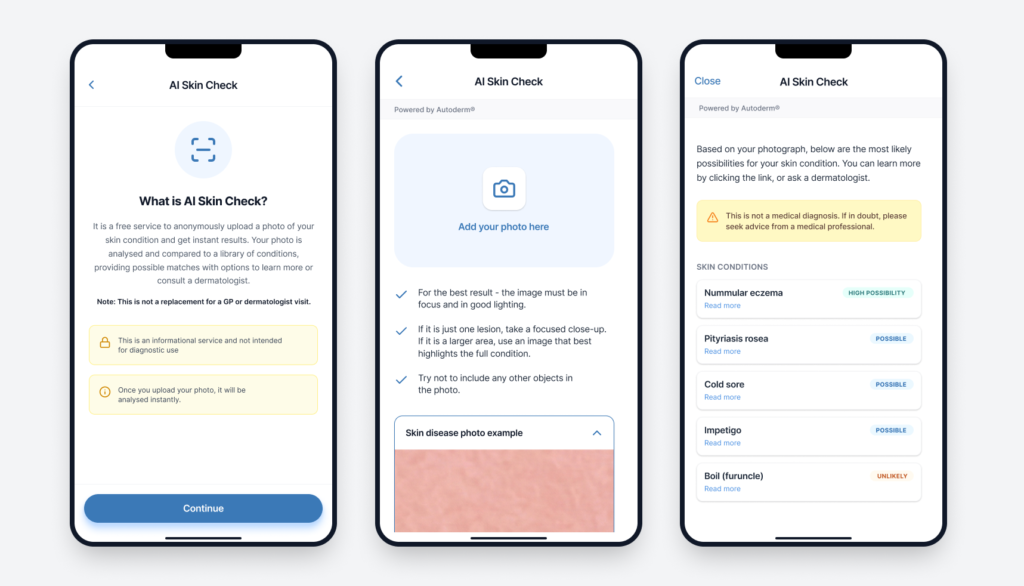 Autoderm AI skin check feature as displayed in a primary care app
There are several primary care apps used in major European markets fulfilling screening, diagnosing, treating and monitoring of illnesses. AI skin analysis is just one of the many helpful tools available in your digital health app.
When you are using an AI skin analysis tool you can anonymously upload an image of your skin concern. Once you upload the photo it will be analysed by Autoderm’s CE-marked, MHRA-registered AI. Your image will be compared with a library of dermatological data and the system gives you a ranked list of up to five possible skin conditions.
But you should understand that this information should not be considered as equal to consulting a dermatologist, instead it is a guidance empowering you to manage your skin condition more accurately and seek professional help in a timely manner.
Autoderm operates entirely in the background as a fully white-label API. This means the app developers have complete control over how the tool looks and feels in order to ensure it’s user friendly nature. They choose how to explain the results to you and decide which helpful next steps to suggest whether that is chatting with a pharmacist or booking a video call with a doctor.
The architecture
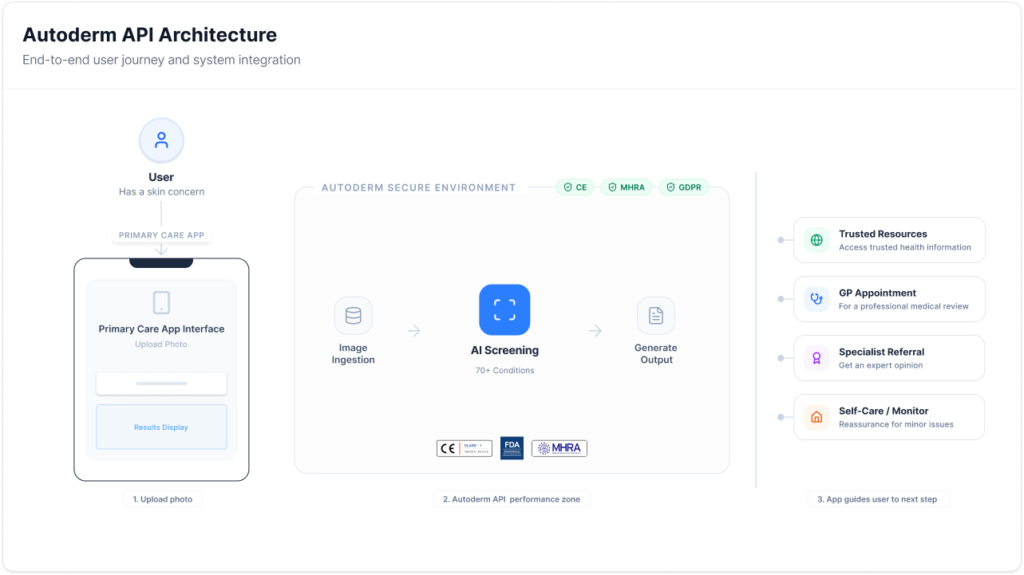 Autoderm API architecture showing the end-to-end user journey and system integration
Why digital primary-care platforms use Autoderm’s AI
Skin analysis tool designers have made sure it being as simple as taking a photo. Here are the simple steps of using the app.
Step 1: Image Upload Within the App
You can find the skin scanner directly inside your app. You don’t need any special equipment or extra gadgets your standard smartphone camera is all you need. To help the AI work its best, the app provides clear tips on how to use good lighting and how to frame the area of concern.
Step 2: AI Image Analysis (Autoderm API)
Once you upload the photo, the Autoderm system gets to work. It compares your image against a massive, constantly updated library of professional skin images. The process is quick and only requires a single photo to identify a wide range of common skin conditions.
Autoderm is bound to ensure the safety and quality of the results you receive.
Step 3: Results Presented to the User
The results are shared with you in plain, non technical language. You will see a list of the most likely possibilities to help you understand what might be going on.
It is important to understand that these results are for your information only and are not a formal medical diagnosis. Since everyone’s skin is unique, you should always talk to a doctor or GP if you are worried.
Step 4: Deciding on Your Next Move
At this point, responsibility shifts entirely to the app provider. After you see the results, the app helps you decide what to do next. Autoderm provides the information, but the app itself connects you to actual care. Depending on your results, you will be asked to
- Visit a Pharmacy: Good for minor issues that can be handled with over-the-counter care.
- Book a GP Appointment: Use the app to schedule a visit with your regular doctor.
- Speak to a Specialist: Some apps offer a way to get a full review from a human dermatologist through a video call or a telemedicine service.
- Take No Action: If the results provide the reassurance you needed for a minor, self-limiting concern.
The responsibility of Autoderm in this process is only to analyze the image you’ve provided. It does not contribute to providing medical advice, writing prescriptions, or making treatment decisions. Those steps are handled separately by the app’s other clinical service providers.
These apps know that health data is sensitive, so your photos are processed and stored anonymously, meaning no personal details like your name or address are attached to them. This system is built to follow strict European data protection rules to keep your information safe.
Why digital primary-care platforms use Autoderm’s AI
Using Autoderm’s AI in skin health is not intended to replace the professional input completely. From a healthcare perspective, adding AI skin analysis to an app isn’t just about technology either it’s about making the entire system work better for you and your doctors.
Here is how this tool helps improve your experience,
- Better Awareness for You: You get structured, helpful information about your skin before you even speak to a professional.
- Clearer Expectations: When you do decide to seek medical help, you’ll have a better idea of what to ask, making your appointment more productive.
- Shorter Wait Times: By helping people identify minor issues that can be handled at home or by a pharmacist, it frees up GP appointments for those who need them most.
- Help Anytime: You don’t have to wait for your local surgery to open. You can check a skin concern in the middle of the night or over the weekend.
- Drives Engagement and Stickiness: It adds a valuable, “sticky” feature that encourages repeat user engagement, building long-term loyalty and creating more opportunities for interaction within the app.
- Rapid, Developer-Friendly Integration: The fully white-label API is designed for speed and simplicity, allowing a platform’s development team to integrate the feature and go live in a matter of hours, not months.
- Built for E-Health Integration: Designed for secure, compliant integration with national e-health infrastructures, ensuring data protection and interoperability.
- Safe Boundaries: The roles are very clear: the AI provides the initial information, while qualified human clinicians provide the actual medical care.
- Trusted and Secure: These tools are built to follow strict safety and privacy rules (like GDPR and MHRA standards), so you can trust how your data is handled.
Essentially these AI outputs are intended to support awareness and do not replace professional medical assessment.
Observed user behaviour and platform impact
Carefully looking into how these tools are being used in real life, gives clearer patterns. Most people use AI skin analysis as the first step in their health journey.
Here is how it typically fits into a person’s day:
- A Quick Information Check: It acts as an early-stage tool to gather basic information about a skin concern.
- Deciding What to Do Next: It helps you decide whether you need to book a doctor’s appointment or if a different path might be better.
- Peace of Mind: For many common and harmless skin issues, it provides reassurance.
This reliability is not just based on internal data; it is validated by independent clinical research. For instance, a 2019 study conducted in a live primary care setting in Spain explored the real-world impact of Autoderm’s AI. The study found the AI’s diagnostic support performance to be on par with that of General Practitioners.
Crucially, the tool was embraced by clinicians, with 92% of participating GPs finding the AI useful in their daily workflow. From an efficiency standpoint, the research highlighted that using the AI could have avoided the need for a specialist referral in 34% of cases, directly supporting better resource management. Regarding safety, the AI demonstrated its value as a critical safety net. In the study, it showed 100% sensitivity in identifying potential cases of melanoma for urgent professional review, underscoring its role in encouraging timely assessment for the most serious concerns.
The most important thing to remember is that while this AI doesn’t replace a real doctor, it is a powerful companion. It helps you go into your medical appointments with much clearer expectations and a better understanding of your own health.
Validating the core technology: Performance against specialist reference standards
Beyond improving clinical workflows, the core Autoderm AI engine has been validated for its diagnostic accuracy against specialist reference assessments. This evaluation was designed to confirm the technology performs reliably within its intended role as an early-stage, decision-support tool.
In a comparative evaluation using 91 confirmed skin condition images, the AI’s performance was directly compared to that of board-certified dermatologists. The results demonstrated a high degree of reliability and safety:
- Top-5 Diagnostic Accuracy was 93%, meaning the correct potential condition was included in the AI’s list of suggestions in almost every case. This performance was on par with the dermatologists’ assessments, validating its effectiveness as a triage and informational tool.
- Most importantly, the Treatment Recommendation Accuracy was 95%. This is a critical safety metric. It shows that even where the top suggested diagnosis might vary, the underlying recommended action is exceptionally reliable.
These findings provide confidence that the core technology is built on a clinically responsible foundation supporting users and platforms with reliable early insight, while preserving the dermatologist’s role as the final authority.
Supporting primary-care capacity through clearer user pathways
Digital front-door platforms play an important role in managing high demands across primary care services. By giving early information users need, these tools help users to understand which level of care is needed for a given specific situation.
These platforms guide users to the most effective next steps by helping them identify when:
- Community pharmacy services may be the quickest and most appropriate option for minor issues.
- A GP or specialist review is advisable for more complex or concerning conditions.
By using AI-supported tools, health platforms can create more efficient care pathways. This approach ensures that you get the right information at the right time, while always maintaining your personal autonomy and safety. Most importantly, it preserves clear clinical boundaries, ensuring that professional medical care is prioritized for those who need it most. For platforms, this creates clear, commercially viable pathways to seamlessly connect users with premium services, such as paid specialist consultations, or to establish structured pathways suitable for statutory reimbursement frameworks.
Future role of AI skin analysis in primary-care apps
As digital health platforms continue to grow and evolve, tools like AI skin analysis will become even more helpful and integrated into our daily lives. In the future, you might see these tools expanding in several exciting ways.
- Targeted Support for Common Conditions: AI could provide specific, helpful pathways for managing long-term skin issues like eczema or acne, giving you information tailored to your needs.
- A “Pharmacy-First” Approach: The app could more easily guide you to local pharmacy services for minor concerns, saving you a trip to the doctor.
- Helpful Reminders: Imagine your app sending you a gentle nudge for ongoing skin care or reminding you to check a specific spot again in a few weeks.
- Smarter Guidance: Apps will likely get better at “triaging,” using clear rules to help you decide exactly when a skin issue needs to be escalated to a professional.
- Integration with national e-prescription and digital referral systems.
- Health Education: These tools will play a bigger role in teaching all of us how to better care for our skin and what signs to look out for.
Conclusion: AI as an informational layer in digital primary care
In today’s world, digital primary-care platforms are reshaping how people engage with health services in everyday life. By using tools like AI skin analysis, these apps act as a helpful first step when you have a health concern without bypassing clinical safeguards.
Think of this technology as an “informational layer” it’s there to give you a better understanding of a skin issue early on, without skipping the important safety steps of seeing a professional.
By including Autoderm’s high-quality AI, health platforms can give you quick information while making sure you are always guided toward the right kind of care. It keeps a very clear line between providing helpful information and actual medical treatment, ensuring your health is managed safely and reliably.
FAQ: How does AI skin analysis improve primary care capacity without compromising patient safety?
AI skin analysis in primary care apps operate as an informational front door, supporting early user awareness rather than replacing clinical assessment completely. It helps users to understand possible skin concerns, and help them in deciding whether professional care may be needed.
Within digital primary-care platforms, the technology analyses a single uploaded image and returns a ranked list of possible skin conditions to provide immediate informational guidance. The results are clearly framed as informational, and apps do not provide medical diagnosis or treatment recommendations.
These steps have been taken in order to ensure patient safety through clear role separation. Clinical responsibility remains entirely with healthcare professionals and the platform’s defined care pathways. Any GP appointment, specialist review, prescription, or treatment decision takes place independently of the AI system.
By supporting earlier awareness, AI skin analysis helps reduce unnecessary appointments for minor or self-limiting concerns, while encouraging timely professional review when appropriate. This contributes to more efficient use of primary care capacity without bypassing established safeguards.
In this model, AI strengthens access and efficiency by guiding users toward appropriate next steps, while preserving accountability, regulatory compliance, and trust across primary care services.
References
- Escalé-Besa A, Yélamos O, Vidal-Alaball J, et al. Exploring the potential of artificial intelligence in improving skin lesion diagnosis in primary care. Sci Rep. 2023;13:31340. Published March 15, 2023. doi:10.1038/s41598-023-31340-1
- Börve A, Molina-Martinez R. A pilot study of a medical information service using mobile phones in Sweden. J Telemed Telecare. 2009;15(8) https://doi.org/10.1258/jtt.2009.009002
- Zakaria A, Maurer T, Su G. Impact of teledermatology on the accessibility and efficiency of dermatology care in an urban safety-net hospital: a pre-post analysis. J Am Acad Dermatol. 2019;81(2)